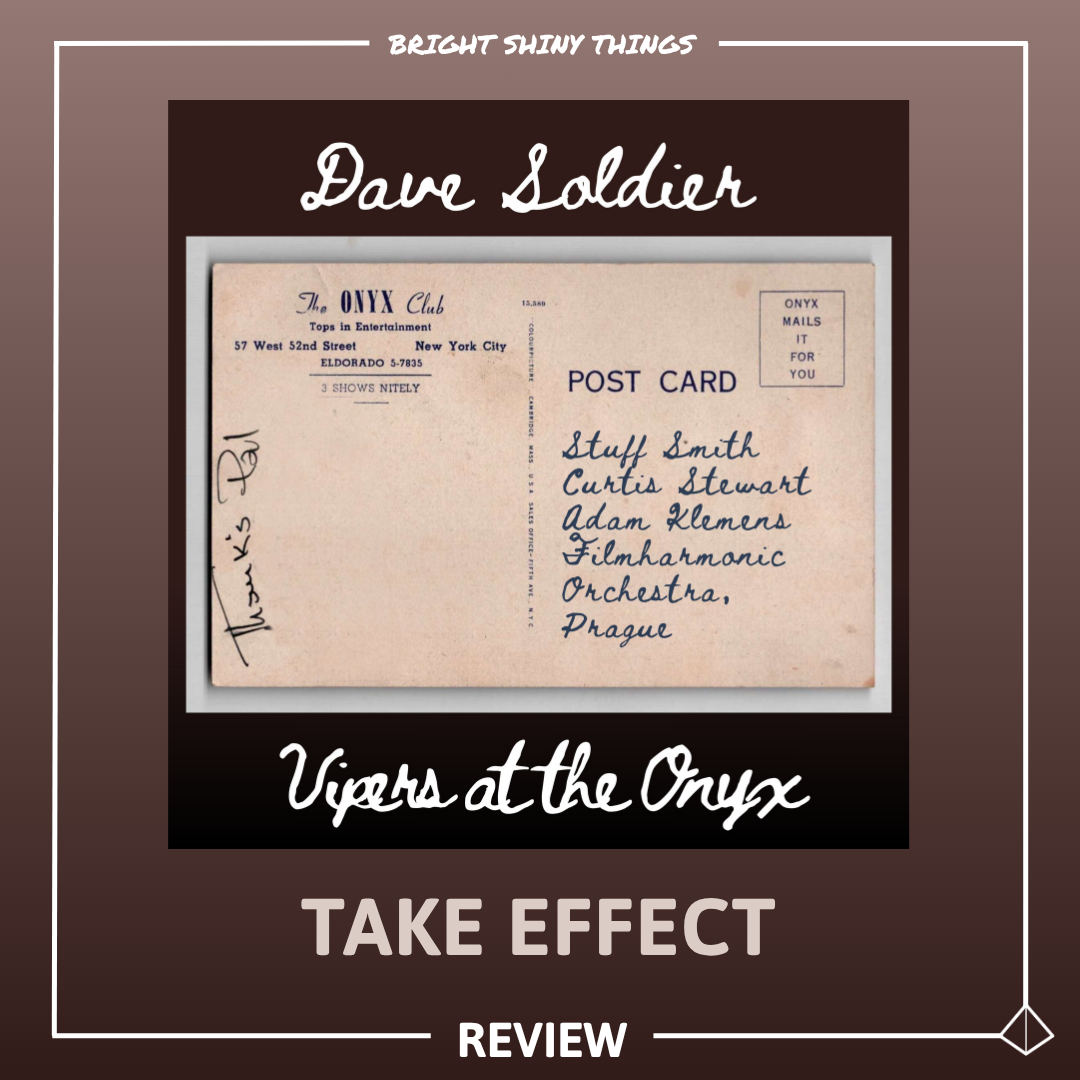
Vipers at the Onyx
PRAGUE FILMHARMONIC
Conducted by ADAM KLEMENS
CURTIS STEWART, JAN VOBORIL
COMPOSED BY DAVE SOLDIER
FOR YOUR
GRAMMY® CONSIDERATION
Best Orchestral Performance
Best Contemporary Classical Composition
Dave Soldier: Stuff Smith's Unfinished Concerto
Best Engineered Album, Classical Jan Holzner

“This is a brilliant musical portrait of American composer and neuroscientist Dave Soldier. Virtuosic, expressive and full of life.”
— BBC Music Magazine ★★★★★
“Across all tracks, the Prague Filmharmonic Orchestra under Adam Klemens brings the tight ensemble work and zest necessary to enact the constant shifts in Soldier's lively scores.”
— AllMusic ★★★★★
“I listened to this first when I received the album and then went back and listened to the whole recording. It was that compelling.”
— Cultural Attaché
ABOUT
LISTEN
Vipers at the Onyx is the first album of symphonic works by American musician and neuroscientist Dave Soldier. Performed by the Prague FILMharmonic Orchestra led by Adam Klemens, it features the world premiere of Stuff Smith’s Unfinished Concerto performed by violinist Curtis Stewart, expanding upon a home tape of themes by the 1960s jazz violin legend. Framed by tributes to Eddie Palmieri, nueva canción, and Korean percussion, the album distills Soldier’s adventurous cross-genre musical life.
ABOUT The ARTISTS:
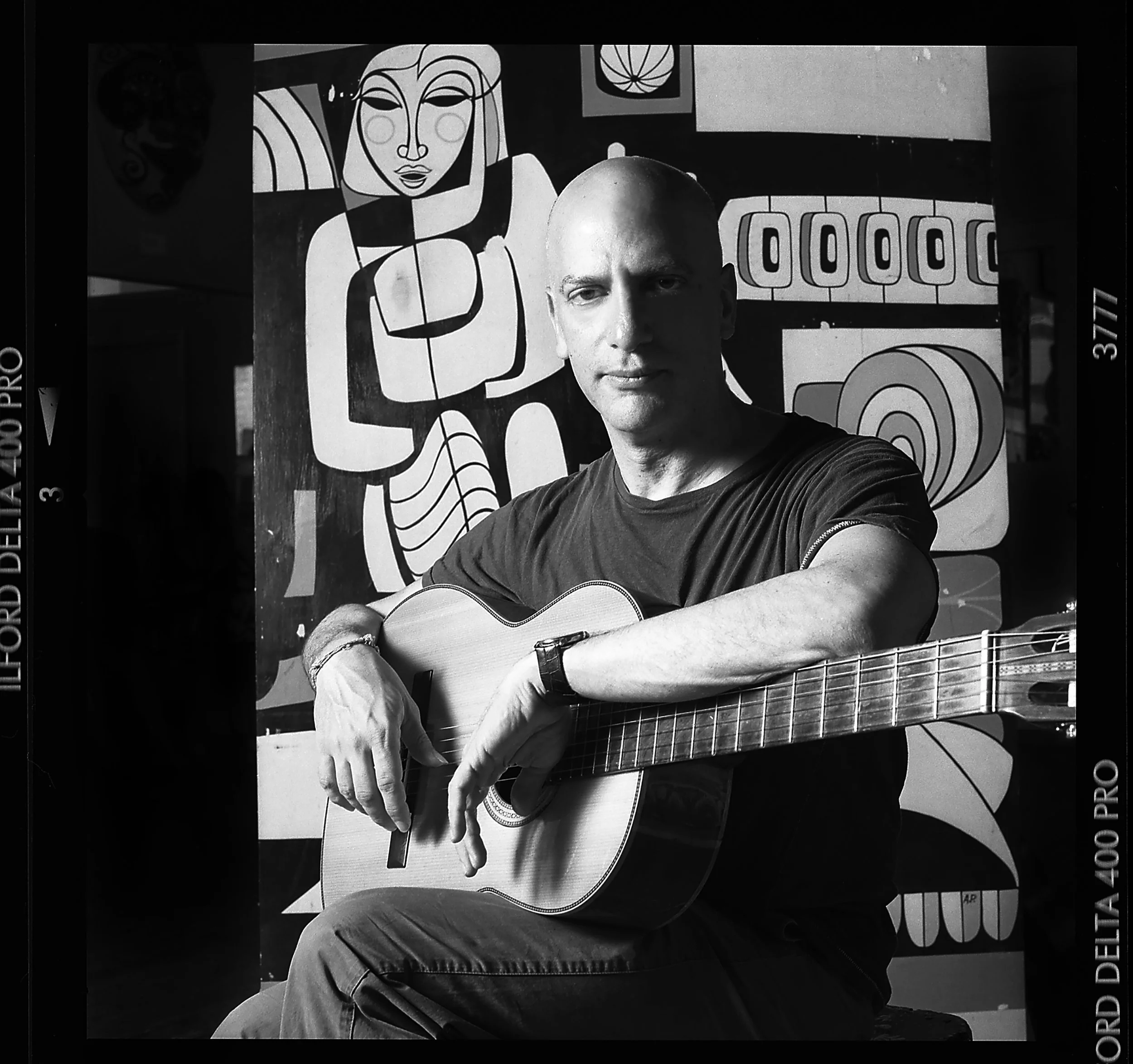
Photo Credit: J Maya Luz
Dave Soldier leads a double life as a musician and a neuroscientist. Growing up in Carbondale, Illinois, he toured with country and rock bands as a violinist and guitarist in his teens and early twenties, including a stint as guitarist with rock n’ roll pioneer Bo Diddley. Inspired to be a composer by Eddie Palmieri’s records, he studied composition at age 17 with Roscoe Mitchell of the Art Ensemble of Chicago, and in his twenties with Otto Luening, an electronic music pioneer who co-invented the synthesizer, as well as at night school at Juilliard. He studied violin with Anahid Ajemian, leader of the Composer’s String Quartet, the principal contemporary string quartet at the time. Moving to New York in 1981, he rapidly became involved in the “downtown” rock, jazz, and classical scene, performing with most of the performers in those styles. In 1984, he formed the Soldier String Quartet, a group that played amplified instruments with drums at venues like CBGBs and Lincoln Center and toured widely with members including Regina Carter, as well as others who then started their own contemporary quartets. The Soldier String Quartet helped usher the use of hip-hop, R&B, and punk rock into composed classical music in the 1980s and was John Cale’s touring and recording band from 1992-1998, performing Soldier’s arrangements of Cale’s songs. The group further performed and recorded with each of the members of the Velvet Underground, David Byrne, Ric Ocasek, Guide by Voices, Van Dyke Parks, Henry Threadgill, Amina Claudine Myers, Tony Williams, Teo Macero, and premiered quartets by dozens of composers, recording many albums, including several of Soldier’s compositions.
Beginning to feel stifled in the contemporary classical and downtown worlds, Dave Soldier began to explore alternative ways of creating music. In 2000, he cofounded, with conservationist Richard Lair, the Thai Elephant Orchestra, a group of 14 elephants for whom he built giant instruments and recorded three commercial albums. He transcribed one of their improvised pieces, The Ganesha Symphony, as his Symphony No. 1, which was recently recorded by David Cossin and the MassMOCA percussion ensemble. Continuing on the idea of collaborating with non-professional musicians, he created recording projects with children, including in rural Guatemala (Yol Ku: Mayan Mountain Music) and New York's East Harlem (Da HipHop Raskalz), and with songbirds and bonobos. Returning to his roots in country and blues music in the Midwest and South, he formed a long-running Memphis/New York Delta punk band, the Kropotkins. Most famously/infamously, he composed The People's Choice Music: the most wanted and unwanted songs following poll results of likes and dislikes of the American population with the Russian protest artists Komar & Melamid. Ironically, the Least Wanted Music is his most frequently streamed piece. He composed two cycles/oratorios in collaboration with Kurt Vonnegut, and a broad array of chamber, opera, and classical works, in addition to jazz, rock, and flamenco recordings. Vipers at the Onyx is Soldier’s first album of his music for symphony orchestra and reflects all of these extraordinary experiences and passions.
While participating in all of these artistic projects, Soldier received a PhD in biology at Columbia University, where, in his day job, he is David Sulzer, a neuroscientist and Professor at Columbia University in the Departments of Psychiatry, Neurology, and Pharmacology. His lab investigates the synapses of the cortex and dopamine system in habit formation, planning, and decision making. His lab has made major contributions to understanding the action of addictive drugs and the causes of diseases and neurodivergence, including Parkinson's, Huntington's, ALS, schizophrenia, and autism. They developed the first methods to directly measure the fundamental unit of neurotransmission (quantal neurotransmitter release) and the first optical method to visualize neurotransmission at the synaptic level in the brain. Soldier is a leader in the fields of neuroimmunology and the brain processes involved in learning.
A few projects unite these personalities. In 2022, Dave published Music Math and Mind (Columbia University Press), a book that explains the math, physics, and biology underlying music, and he teaches an annual college course on the topic. Dave recently realized Johannes Kepler’s instructions from the year 1619 for the music of the spheres, recording Motet: Harmony of the World with the microtonal vocal ensemble Ekmeles. With computer musician Brad Garton, he initiated the Brainwave Music Project, which allows people to perform using their brain's electrical activity and teaches audiences about the nervous system. With the Nobel laureate chemist Roald Hoffmann, Dave ran the original science cafe, Entertaining Science, at the Cornelia Street Cafe. He has a series of pieces that use mathematical transformations, including fractals and calculus, to create new repertoire, such as a 20-minute version of Chopin's Minute Waltz. Learn more at www.davesoldier.com.